
Tales of Two Cinemas and Two Families
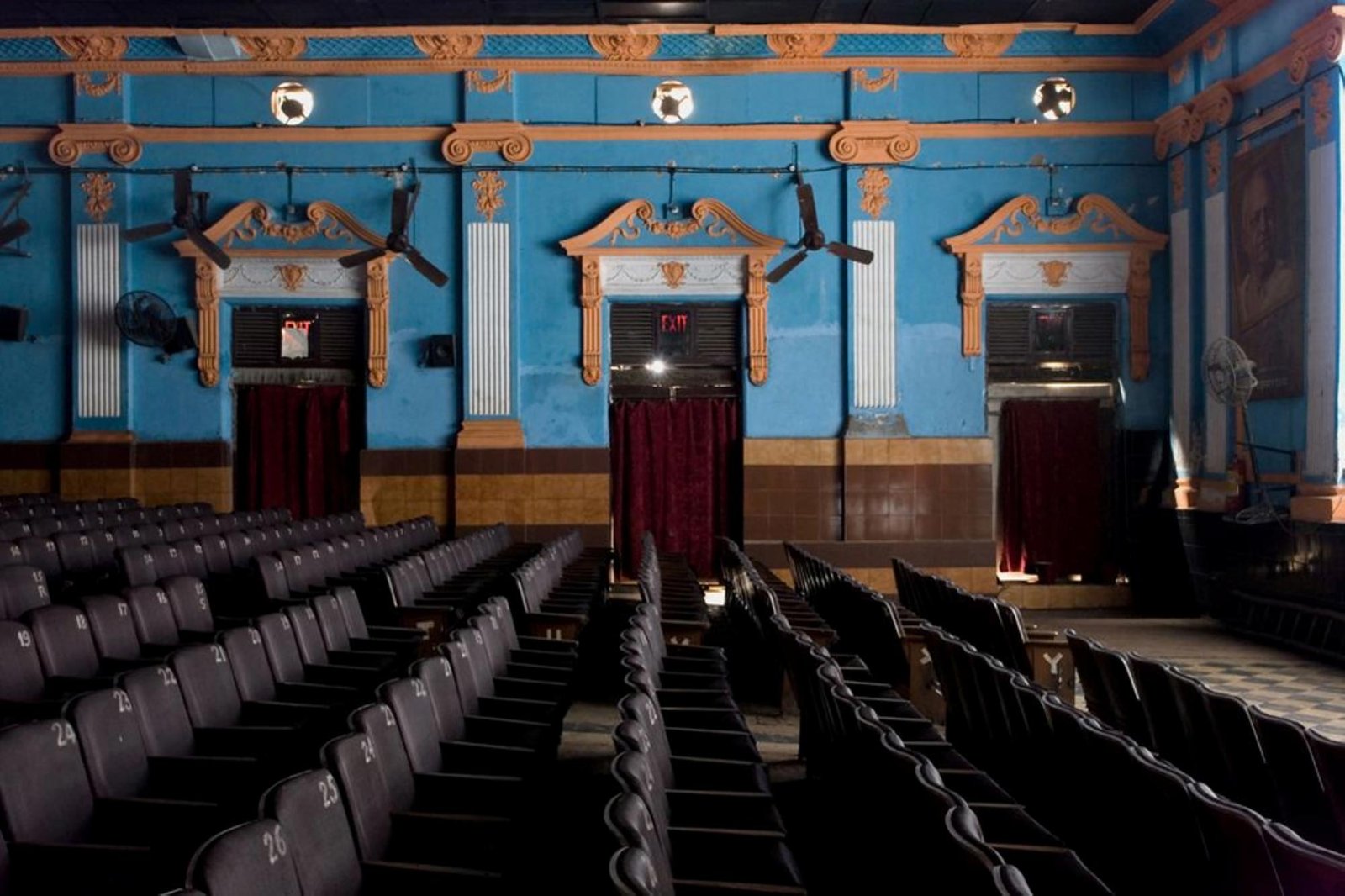
This is a study of the Bharatmata and Liberty theatres, two iconic albeit very different single-screen cinemas in Mumbai. Discussing them together highlights the stories of two Indian families who have long sustained and fought to preserve their respective theatres across three generations. This juxtaposition reveals two distinctive film cultures, architectural designs, and landmarks. Social, political, and cultural controversies (past and present) surrounding these cinemas are also at issue here. As more and more single screens are abandoned or demolished and the film industry cuts back on theatrical releases, strategies and tactics from India and the US are explored here to imagine a tomorrow for these cinemas today. What follows is an historical account drawn from primary and secondary sources, interviews with theatre owners, staff, and audiences, and the experience of making a documentary about the Liberty and other Indian single screens. Here the author takes on the voices of critic and advocate as well as historian.
Early Migrations of Film and Architecture
Film has a long and complex history in India beginning in 1896 when the Lumière Brothers, pioneers of moving pictures[1], exhibited their actualités (scenes of real life) at Watson’s Esplanade Hotel in Bombay (now known as Mumbai). The Lumières aimed “to show the world to the world” by sending their cameras, operators, and films of modern life across the globe.[2] They aptly chose Bombay, long a center for cosmopolitan trade and culture, for what was probably the first film screening in Asia at Watson’s.[3] Located in south Bombay, the seat of British colonial power, the hotel migrated there from the West just like the Lumière films. Constructed of cast and wrought iron parts manufactured in England, its prefabricated architecture was shipped and then assembled on site.[4] Here the histories of film and modern architecture first converged.
Soon screenings were taking place in other repurposed venues like saloons, variety halls, boxing rings, tents, and theatres for ballet, opera, and drama in Bombay and across India. Adaptive reuse was part of early cinemas’ architectural DNA from the outset. And such repurposing and reinventing are needed today if single screens are to have a future.
Hemant Chaturvedi, cinematographer and filmmaker, has photographed and researched over 1, 250 single-screen cinemas across India since 2019. His images and recovered histories are an invaluable archive. Whereas three decades ago 25,000 were still operating, there were, Chaturvedi stated, only some 6,000 single screens left by 2024. Ironically, India, a nation of cinephiles, is today one of the world’s most “under-screened” countries. There are only seven to eight screens per million inhabitants. Owners of single screens have long struggled with onerous entertainment taxes, property assessments, utility rates, and boom- and bust-box office cycles. The advent of video cassettes and DVDs in the 1970s and 1990s respectively and then multiplexes siphoned off filmgoers. Streaming services, smart phones (essentially hand-held cinemas) and Covid lockdowns caused even more single screens to shutter.[5]
Deities and Independence
Unlike the Bharatmata and Liberty, Bombay’s first cinemas were named after British rulers (Victoria) or London theatres (Novelty) or Hollywood studios (Metro for Metro-Goldwyn-Mayer). Some that followed, however, began honoring Hindu deities like Laxmi, the Bharatmata’s original name. It was an auspicious choice given she is the goddess of prosperity and wealth. Divinities were also featured in the films projected on the screen. Dadasaheb Phalke, film pioneer and staunch nationalist, created the genre of mythological films drawn from Indian religious and literary epics like his Raja Harishchandra (1913), India’s first feature film. Traveling cinemas even screened mythological films near temples of the deities depicted.[6] The Bharatmata and other theatres erected idols and shrines in their lobbies and courtyards. They were also specially decorated for religious festivals like Diwali when studios released their most eagerly awaited movies and filmgoers wore their very best.[7]
Opening after independence, the Liberty’s name celebrated the new Indian nation. During the struggle for freedom, a rallying cry was “to be a good Indian, see an Indian movie.” Filmgoing became part of the nationalist boycott of foreign goods; and patronizing Indian films was akin to making and wearing khadi, an assertion of Indian self-reliance and independence. [8]
Film was a mass medium, accessible to both the literate and illiterate. Even before sound pictures, the talkies, in-house narrators read silent films’ intertitles to audiences. Although Hollywood films had first dominated the Indian market, the production of Indian films increased markedly by the 1930s.[9] Mythological films were promoted as respectable and uplifting entertainment unlike the escapism and risqué scenes of Hollywood movies. During the 1920s and 1930s, “social reform” films about dowry, child marriage, and untouchability emphasized Indian morality and capacity for self-rule.[10]
Large crowds congregated around cinemas (some seating more than a thousand filmgoers) in Bombay and other cities. And colonial authorities grew increasingly concerned, especially about controlling working-class men gathered there. Already contending with sectarian tensions, labor strikes, Bolshevism, World War I, and the independence movement,
British rulers saw filmgoing as yet another threat to their social and political order.[11] The censor board they established in 1918 prohibited screening any movie deemed harmful to morality, public order, or national interest.
As Lawrence Liang wrote, censorship in India had “its origins… in the anxieties around the new space that cinema [halls] enabled.”[12] And such fears of unrest and violence at cinemas have persisted into the present.
Bharatmata and Liberty: Cinemas of Independence
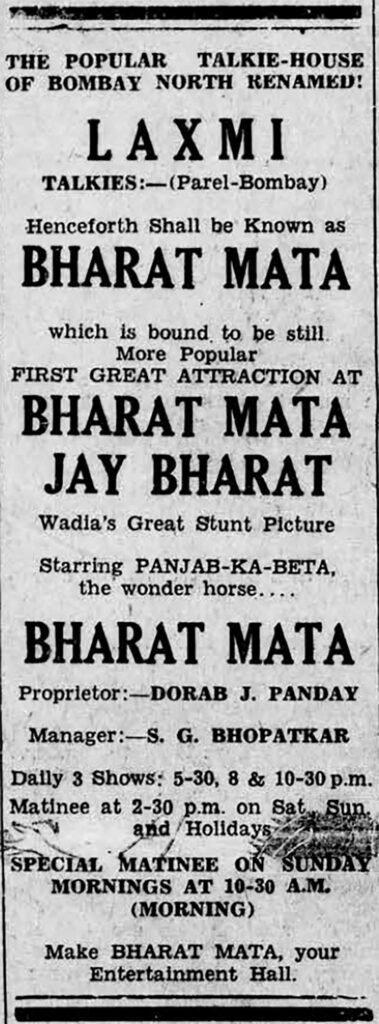
The Bharatmata and Liberty show the tight weave of family, place, and nationalism in Indian cinemas. Originally called the Laxmi, the Bharatmata was renamed after the nationalist rallying cry of Mother India in 1937 (Figure 1).[13] Construction of the Liberty began just as India celebrated independence, hence its name, when it opened two years later in 1949. Both theatres have been family businesses for three generations with origins in Bombay’s cotton and textile trades. [14] Elaborated in what follows are their distinctive audiences, film programs, and architectural styles.
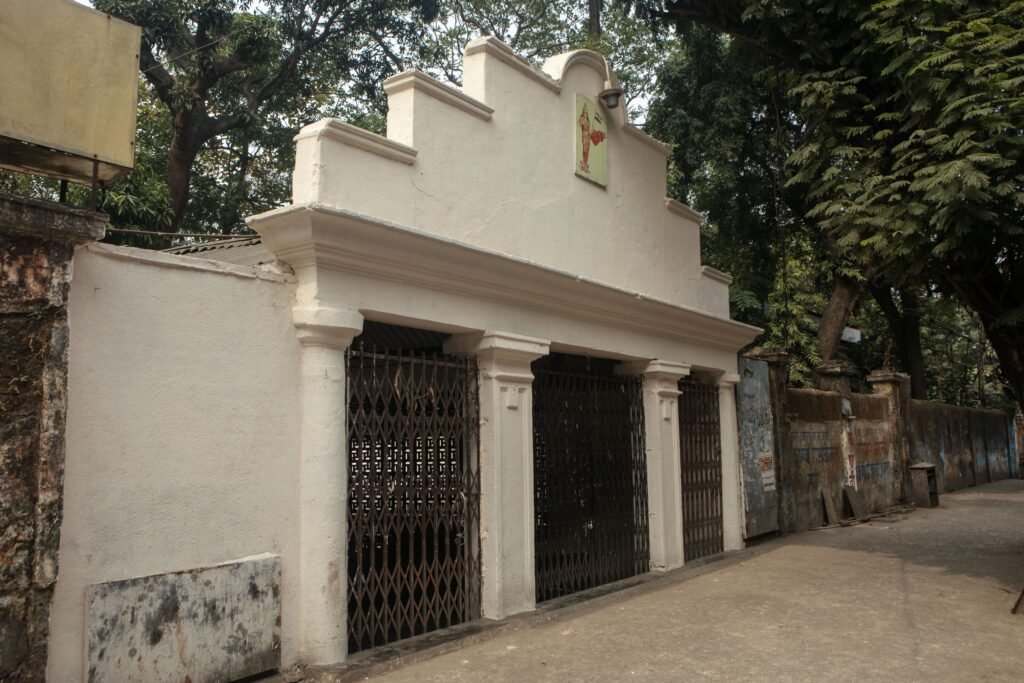
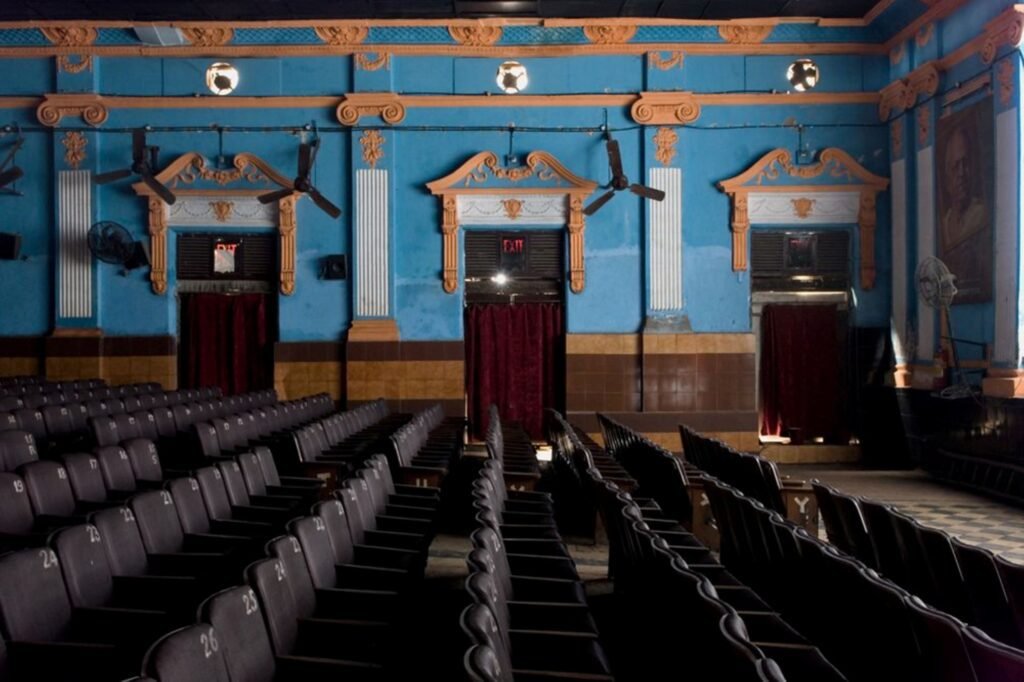
Built on land owned by the adjacent textile mill, the Laxmi was built to entertain factory workers and superintendents.[15] Clean lines and simple geometries characterize its curved gable, stepped parapet, and entry portico of Tuscan piers and engaged columns (Figure 2). The façade’s austere design is a decided contrast to the elaborate Neoclassical moldings, Ionic pilasters, and swan’s neck pediments awaiting filmgoers inside the theatre.[16](Figure 3). According to Kapil Bhopatkar, managing partner of the Bharatmata, his grandfather Sadashiv (a film distributor in Madhya Pradesh) took over the cinema’s management because the mill managers had no idea how to run a theatre. News of Sadashiv’s publicity stunts, like dropping thousands of film pamphlets from a friend’s airplane on market day, had reached them. His grandfather, Kapil recalls, renamed the theatre Bharatmata, and he began screening Marathi films.[17]
Because the factories operated for ten to fourteen hours, film screenings were timed to the mills’ shift changes. At one point the Bharatmata was open around the clock. [18] In a city starved for public spaces, it was one of the few places where people could simply relax, pass time, and be entertained for very little money.
The Marathi films at the Bharatmata spoke the same language as the early mill workers, locals and migrants from the countryside. It and other cinemas in the mill lands were part of the city’s vibrant working-class culture, known for its political protests, militant trade unionism, Lalbaugcha Raja, and clan- and folk-based traditions of music and drama.[19]
After his father’s sudden death in 2000, Kapil (whose careers are in finance, banking, and academia) took over managing the theatre. Despite many challenges he and his father honored Sadashiv’s commitment to Marathi films at affordable prices. While stall tickets cost twenty-five rupees and balcony ones thirty rupees in 2012, eight years later the most expensive ticket was only eighty rupees or about the price of a samosa snack at a multiplex. “In this new world of supermarkets,” Kapil noted, “Bharatmata is still your friendly neighborhood grocery store.”[20] After the National Textile Corporation, his landlord, announced plans to demolish the cinema for a shopping mall and multiplex, he waged a long fight against eviction. With the support of filmgoers, trade unionists, and Marathi actors and directors he saved the cinema. Then just as he was undertaking extensive improvements Covid lockdowns closed it and cinemas across India in 2020.[21]
Nazir Hoosein’s grandfather, like Kapil’s, also migrated to Bombay. Originally from the Kutch, the Hoosein family patriarch was a cotton trader who educated his son Habib to follow in his footsteps. However, Habib was a cinephile who began showing films at the Bandra Gymkhana every Sunday.[22] During WW II he provided entertainment for Indian and Allied troops stationed in Bombay, Pune, and Deolali with a chain of forty-five cinemas. “Some were in tents,” Nazir recounted, “and some were in proper structures.” Such a sprawling cash-based business proved difficult to control. So Habib began consolidating with a new theatre rivaling the scale, artistry, and technologies of the Regal, Eros, and Metro theatres of south Bombay. While those picture palaces focused on Hollywood films, Habib, like Sadashiv, was dedicated to screening only Indian films.[23] As stated in the commemorative booklet issued for the Liberty’s opening:
a major milestone is passed in the history of showmanship in India. It [the Liberty] is a statement to the Indian people that no theatre can be too good for them or for Indian pictures. To the Indian picture-goer who complained that the finest facilities were being used to show foreign products, the Liberty comes as the promise of a brighter future… in the shape of an ultra modern, air-conditioned luxury cinema dedicated to showing the best of Indian films.[24]
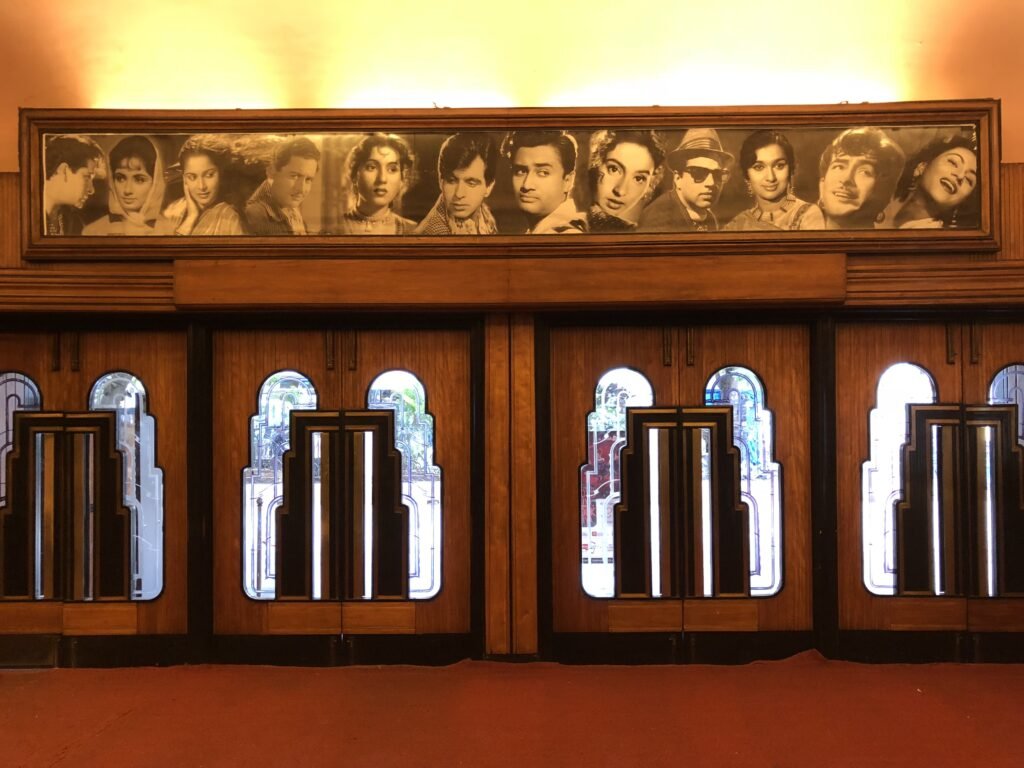
A 1949 photograph of the Liberty shows a crowd of men—many in traditional kurtas and dhotis—and a single sari-clad woman gathered under the marquee announcing the “grand gala opening” of Mehboob Khan’s “lavish ultra modern social Andaz.” It was the first of many iconic Hindustani films, including Khan’s Mother India, premiered at the Liberty.[25] After premieres there were, Nazir Hoosein recalled, dinners for the stars, directors, and producers on the terrace of the family’s penthouse above the cinema. Nargis, Dilip Kumar, Raj Kapoor, and other legendary stars of Hindustani cinema’s golden age (from the late 1940s to the early 1960s) were all family friends. They were depicted in a frieze of black-and-white-photographs in the theatre lobby (Figure 4). The Liberty, however, is a star in its own right, long prized as a location for film, music, television, and now streaming shoots.[26]
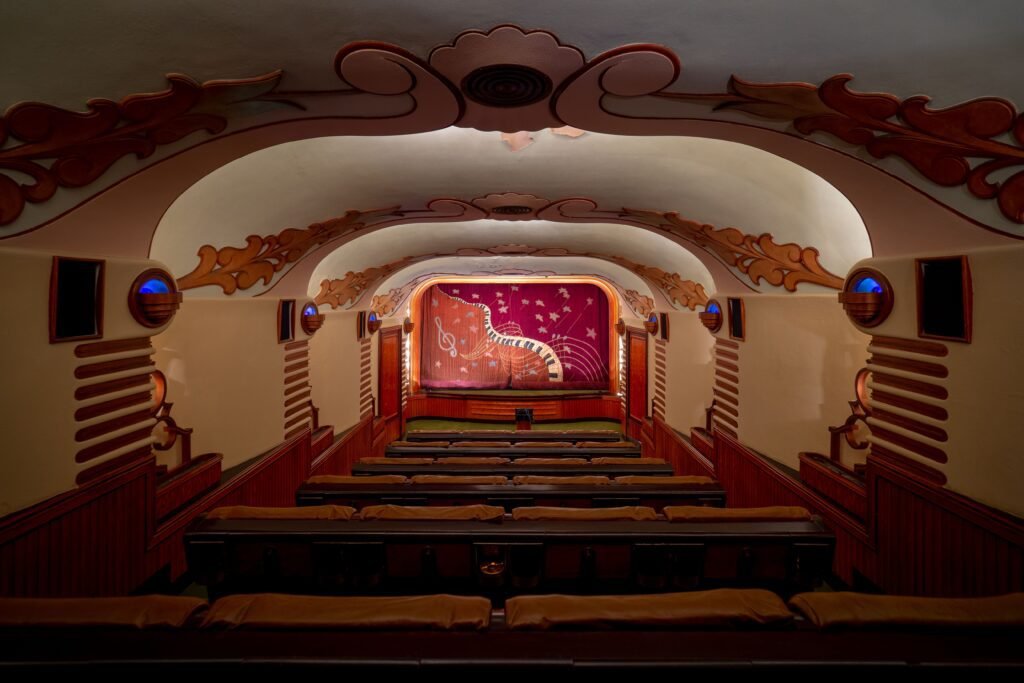
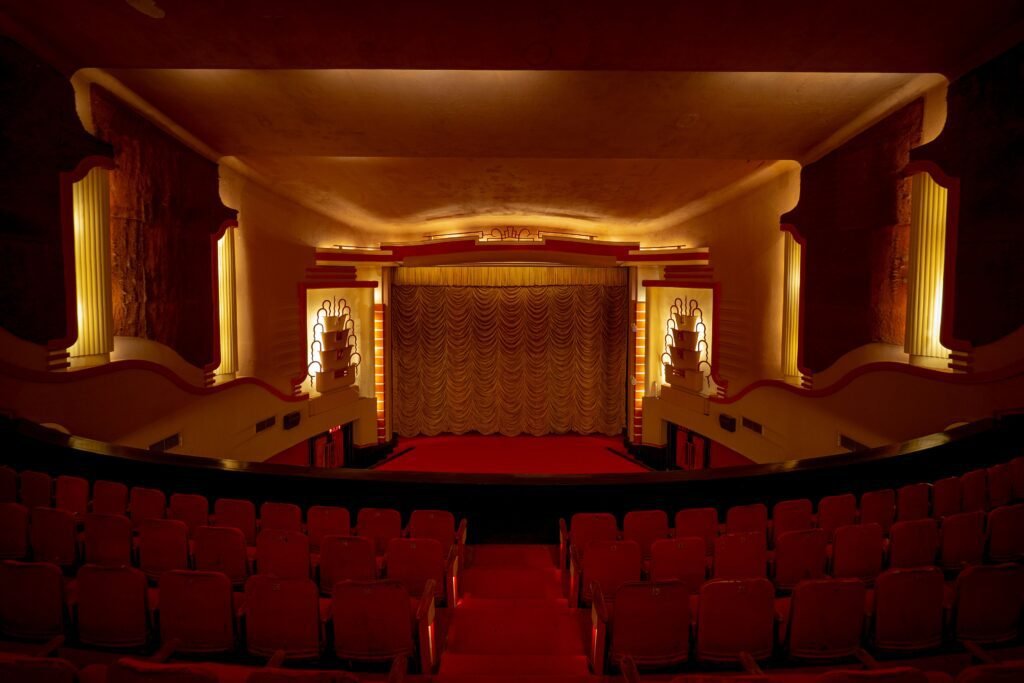
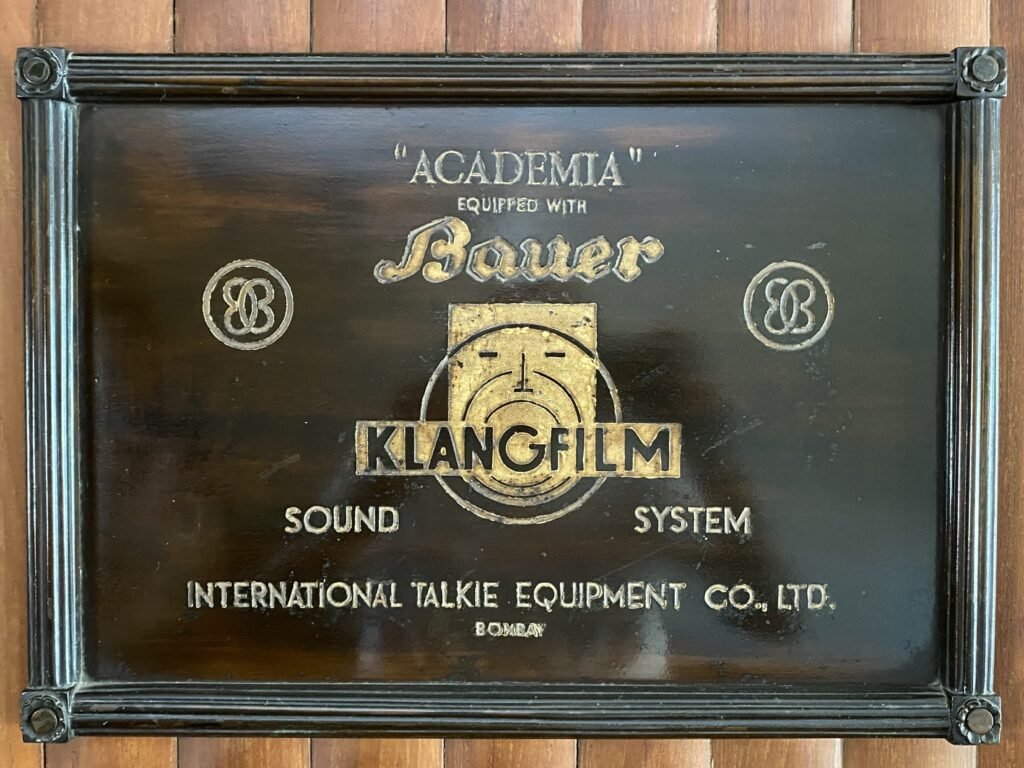
Habib Hoosein was a cosmopolitan as well as an Indian patriot. He loved world cinema and shared it with family and friends in the Academia, his private screening room at the Liberty.[27] It and the main theatre featured materials and technologies from India and around the world (Figures 5 and 6). While India supplied the veined marble complementing the Liberty’s pink-stucco façade, Burmese teak and Canadian white cedar were used for its doors and paneling. Imported from Germany was the Academia’s Bauer projection and sound system (Figure 7); the US provided the Carrier air conditioning, RCA sound system, and Bombay’s first pushback seats in the main theatre.[28] Indian artistry and handicraft were also showcased throughout the Liberty. Divecha Glass Works executed the etched and mirrored glass used extensively in the interiors. While he spared no expense at the Liberty, Habib shrewdly planned the cinema as part of a larger mixed-use building with retail and office spaces to let.[29]
The Liberty, like other cinemas, spawned a robust ecosystem of sociality and commerce around its premises. Nearby businesses like the Liberty Juice Centre appropriated its name. Just opposite the cinema, it still serves a snack named in the theatre’s honor.
Single screens like the Liberty became landmarks for navigating the city with business cards listing addresses as “near or just opposite” a particular cinema. Taxiwalas once knew exactly where to go when simply told “Liberty Theatre.” Informal economies of street hawkers making chai and bhurji and selling crisps and biscuits still line the street in front of the theatre.
Art Deco and Indian Modernism
Despite his patriotism, Habib chose M. A. Ridley Abbott, a Canadian architect associated with a Madras firm, to design the Liberty. However, when Abbott died in a plane crash with only the first story constructed, J. B. Fernandes took his place. He, interior designer Waman M. Namjoshi, and building contractor Motichand completed the Liberty. Nazir also said his father was deeply involved in the Liberty’s design, especially its interiors. Like the Regal, Eros, and Metro picture palaces, the Liberty was inspired by the cosmopolitan styles of Art Deco. Introduced into India during the 1930s and 1940s, Art Deco was the country’s first modern architecture, predating the modernism of Antonin Raymond’s Golconde in Pondicherry and Le Corbusier’s in Chandigarh and Ahmedabad.
Many of the first Indian professionals in architecture, engineering, and construction gained experience of modern technologies and materials like reinforced concrete with Art Deco buildings.[30]
Built of luxurious materials exquisitely crafted, Art Deco’s first incarnation (known as “le style modern” or modernistic or “Jazz Moderne”) was Janus-faced. It looked back to historical styles from around the world and forward to the modernism of skyscrapers, airplanes, and automobiles.[31] Born during the Depression years, streamlined Art Deco combined industrial design’s aerodynamic forms with European avant-garde geometries and abstraction. Because of its simpler forms and less expensive materials, it became the mainstream modernism.[32] Fittingly, the Liberty as a picture palace braided together these two distinct strands of Art Deco to create a lavish architecture for filmgoers whether they sat in the stalls or balcony.
Despite its modern design and technology, Indian Art Deco was also attuned to Mahatma Gandhi’s commitment to “not mass production but production by the masses.” It depended on unskilled headloaders and skilled construction workers as well as expert artisans and builders.[33]
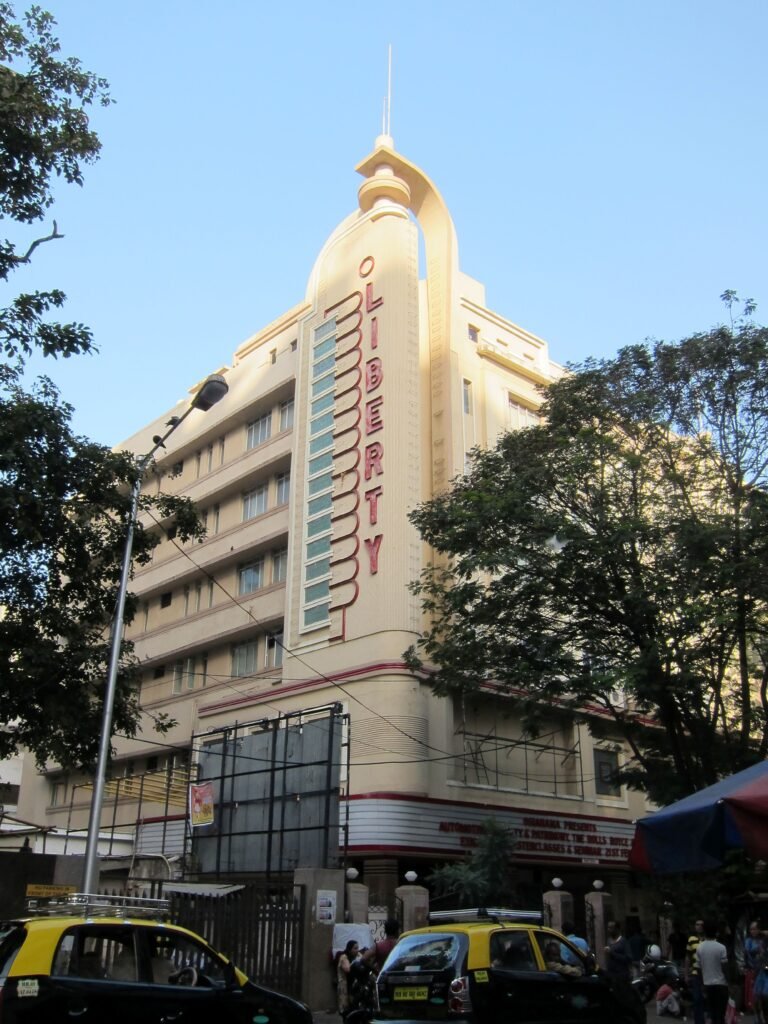
Art Deco transformed traditional Indian forms, materials, and building methods into a mutable and hybridized modernism. Thus the Liberty’s corner tower is a streamlined piano keyboard (signaling the importance of song and music in Hindustani films) with echoes of a temple shikhara in its massing (Figure 8). Since the 1970s Indian films have been called masala for their mixing of action, comedy, song and dance, romance, and melodrama. Like the films it was built to showcase, the Liberty’s architecture is masala too.
Performative Audiences and Architectures
Filmgoing was a social and participatory art in India’s single screens. Men seated in the stalls cheered, whistled, jeered, and sang along with the films. While respectable filmgoers seated in the balcony deplored their boisterousness, even they might join in the sing-alongs originating in the stalls. The artist M. F. Husain was the Liberty’s most famous patron. Smitten with the actress Madhuri Dixit in Hum Aapke Hain Koun (1994), he saw the film fifty times there. Turning down the offer of the Hoosein family’s private box, he preferred to sit in the stalls closest to his idol on the screen. There he could also be seen performing along with her. As Nazir recounted: “And when the music came on the screen, with our surround sound at that time, he would start dancing, and everybody would start screaming, and it was part of the fun and games.”[34] Enthralled filmgoers tossed flowers and coins onto the Bharatmata and Liberty stages in acts of devotion for gods of the silver screen. Because of the danger of fires, the Bharatmata staff confiscated matches from women devotees performing pujas inside the theatre.
As Lakshmi Srinivas found in her studies of Bengaluru audiences, “the social experience of movie-going is as important, if not more important, than the film itself . . . . Cinema theatres are centres of group experience.” Seeing a movie alone, audience members told her, was an “anti-social and unnatural act.”[35]
Namjoshi, the Liberty’s interior designer, became the master of illuminated architecture as performative as the actors on screen and filmgoers in the stalls. His extravagant lighting shows delighted audiences and substantially increased owners’ electricity bills.[36] Red neon delineates the Liberty’s name on its prominent corner tower. Inside the theatre, illuminations morph from white to yellow to red light washing the interior and backlighting the frozen fountains (a popular Art Deco motif) framing the screen. Covered with both elaborate arabesque and streamlined ornaments, the Academia’s walls and ceiling are illuminated by an even more elaborate light show changing from white to yellow to red to green to purple and finally to black light. While the effects were stunning, the means to achieve them were simple: fluorescent paint on the plasterwork and banks of incandescent bulbs coated in colours of the light spectrum.
Collective and Contested Spaces
Single screens were paradoxical spaces: diverse yet stratified; inclusive yet segregated. They were one of the few public spaces where Indians of different classes, castes, genders, and faiths came together. However, inside their darkened spaces, filmgoers were segregated across aisles of power, culture, and difference.
Working-class men occupied the stalls, as noted, the cheapest seats closest to the screen. The better classes kept their distance from the stalls in more expensive balcony seats. While the balcony represented status and respectability, it was also about safety for women at risk of verbal harassment and sexual assault in public spaces. If there were no balcony tickets left, women usually waited until the next show where they were available.
When the first multiplexes opened in the late 1990s, audiences became more homogeneous in terms of class with tickets costing more than double those for single screens. As a result the multiplex filmgoing experience was more sedate and sanitized.
The once diverse and inclusive spaces of many single screens became places of entertainment for largely working- and lower-middle class audiences.[37] Anxieties around filmgoing in any kind of theatre spiked when terrorists bombed cinemas in major cities during the 1990s and early 2000s.[38] After the Super Plaza and Palace Talkies (historic single screens near the mill lands) revived their fortunes with Bhojpuri films, they became targets for vandalism and violence by crowds incited by politicians because their audiences were now Muslim migrant workers from the north.[39]
Resilience and Reimagination
Unlike his father, Nazir Hoosein was no cinephile. But he was completely devoted to preserving the Liberty and ensuring its future. After he and other cinema owners failed to win a reduction in state entertainment taxes, Nazir decided to stop screening first-run movies in 2012. He then focused on promoting the Liberty for concerts, film festivals, symposia, and even stockholder meetings. Glittering events like his father’s premieres returned with a celebration of Fearless Nadia (leading actress and stuntwoman from the 1930s and 1940s) attended by the city’s elite. While one of her films was projected on the screen, a live orchestra accompanied it with a violinist rotating on a trapeze above the stage. The Film Heritage Foundation launched its film conservation program with a gala starring the cinema legends Jaya Bachchan and her husband Amitabh at the Liberty in 2015. Given Nazir’s expertise and passion for all things automotive, he hosted and participated in a symposium on automotive royalty too. Outside the Liberty an exhibition of Rolls Royces and other classic motor cars occupied its forecourt. When another Mumbai theatre backed out of the Kashish Pride Film Festival in 2014, Nazir, a supporter of LGBTQ rights and same-sex marriage, welcomed it to the Liberty. He did draw the line at rock concerts after one performance dislodged some ornamental plasterwork.[40] After his death in 2019 and then the Covid lockdowns, his wife Mrunalini Gole and daughter Aranka Hoosein continue to honor his legacy but not without struggle. Because of staff reductions and soaring costs for electricity and air conditioning, the Liberty is now open only for special events, film festivals, and media shoots.[41]
Bharatmata began running house full again as the quality and quantity of Marathi films improved markedly during the early 2000s. Then Kapil replaced the original carbon arc projectors and sound system. Purchasing the Metro picture palace’s upholstered seats, he repurposed them at the Bharatmata.[42]
After the Covid lockdowns shuttered the theatre for many years, Kapil partnered with corporates (focused on niche and regional theatre chains) to restore and upgrade the Bharatmata in 2024. Two years later the cinema has reopened. Upgrades include laser projection, Dolby surround sound, and improved seating and snacks. Although ticket prices increased, they are still less than those of multiplexes. While preserving its architecture like the Tuscan portico and screening Marathi films were/are priorities, the theatre’s neoclassical orders and detailing did give way to a generic multiplex interior and the inaugural film was a Hindi action movie.[43] But the reopening is cause for celebration. Kapil and his corporate partners resurrected a heritage cinema and the single-screen experience for contemporary audiences. Clearly, they believe in a future for the past.
Single Screens and Community
Clarence Stein, American architect and town planner involved with Chandigarh’s first master plan, believed movie theatres were architectures created for and by communities. Cinemas he designed and planned were also used for town halls, worship spaces, and live performances.[44] Thus a movie theatre was not a cinema around the clock; it took on other roles. Like Nazir Hoosein, Punit Shah also found other lives and purposes for his family’s historic Deepak Talkies. After renovating and renaming it the Matterden in 2014, he resurrected it as a venue for classic, first-run, and independent films.[45] And he also rented it out for private screenings, pre-wedding photoshoots, and even mourning services. Then Covid struck and the Matterden has yet to reopen. Today Mumbai has no real home for art, classic, and independent films. Partnering with private or public entities, surviving single screens could also lease their spaces for pop-up crèches, libraries, job fairs, workshops, classrooms, weddings and other family celebrations. Children’s birthday parties have proved especially profitable for many neighbourhood single-screen cinemas in the US. The Indian United Mills’ weaving shed next to Bharatmata is to be repurposed as a city museum for the history and future of textiles and the textile industry.[46] Thus the cinema might also host museum lectures, exhibitions, and films about textile workers’ lives and cultures.
Single screens need support from diverse communities if they are to have a future. A glittering Hollywood community came together when Jason Reitman and dozens of A-list directors like Steven Spielberg, Christopher Nolan, Lulu Wang, and Ryan Coogler purchased the threatened Westwood Village cinema in Los Angeles. They plan to restore and upgrade this Spanish Revival picture palace for “big screen” movies, [like theirs] “to be enjoyed in the company of large audiences.” Nolan knows the Liberty because it screened a 35mm print of his Interstellar for the Film Heritage Foundation in 2018. In the US some cities and even small towns have rallied to save their historic neighborhood theatres with live performances, school graduations, and children’s parties as well as film screenings.[47] Helmed by Shivendra Singh Dungarpur, the foundation has rallied the film community to conserve and exhibit India’s cinematic heritage. Along with the National Museum of Indian Cinema, it could play a pivotal role in preserving historic single screens where those classic films were once shown.
The family-owned Sahu Group is a pioneer in its support of single-screen cinemas. This corporation financed the meticulous restoration and upgradation of its eponymous cinema in Lucknow (one of India’s first Art Deco picture palaces). Especially important was its decision to maintain it as a single-screen theatre. Netflix and other foreign media corporates have reaped immense profits from producing content by Indians streamed for audiences inside and outside the country.[48] After the damage streaming services have done to single screens, they owe architectural reparations or seed capital to renovate and repurpose these theatres. Given the current state of India-US relations, such support could generate much-needed goodwill for America. Unlike the US, India has a mechanism for such recompense, the Corporate Social Responsibility (CSR) Act of 2013. As the first such law in the world, it would require domestic and foreign corporations of a certain size to invest two percent of net worth or net profits in programs to benefit society. Included are projects for conserving and maintaining monuments and community cultural centers. Admittedly, CSR-funded projects are usually for heritage buildings far older than cinemas; and regulations have often changed for what can be a protracted process. Moreover, cinemas would have to incorporate as public trusts to be eligible. Another path would be for INTACH or other non-profit entities to seek CSR support for acquiring, restoring, maintaining and perhaps repurposing an historic single screen. [49]
Despite its longstanding opposition to theatrical releases, even Netflix saved two historic single screens in the US. The Paris, a mid-century modern picture palace, was Manhattan’s sole surviving single screen when Netflix saved it from being destroyed. The streaming behemoth signed a long-term lease to showcase its films there in 2019. The impetus was, in part, to be eligible for the Academy Awards a film must have at least a limited theatrical release. But Netflix’s rescue of the Paris earned it goodwill and a storied venue for its productions. Even more impressive was its preservation of the Egyptian, Los Angeles’s first picture palace. Netflix spent seventy million dollars to restore and upgrade this Egyptian Revival from 1922 for which it won and deserved a local preservation award.[50]
The Regal, Eros, Metro, and Liberty are Grade II-A Buildings,[51] meaning the Mumbai Heritage Conservation Committee reviews and approves plans to alter or modify them. As designated historic structures, they qualify for Transferable Development Rights (TDR) whereby owners can utilize or sell their unused development rights under certain conditions.[52] India could also adopt tax credits for repairing and restoring heritage buildings as the US has done since 1976. There such programs have generated jobs and revitalized communities. Goods and services levies (formerly called entertainment taxes for cinema tickets and other amusements) could be used to support preservation and adaptive reuse of heritage cinemas.[53] However, many owners shun heritage designation for their cinemas as infringement on their property rights. After proposed amendments to Maharashtra’s cinema law were announced in 2025, owners began preparing plans to redevelop some two dozen single screens as residential and commercial towers including the already required new cinemas. But the Bharatmata’s reopening shows them another way is possible.[54]
The Bharatmata and Liberty, as discussed, are heritage cinemas with different film cultures, audiences, and architectures. They are also different kinds of landmarks.
While the Bharatmata represents the heritage of the Bombay mill lands and working-classes during the independence struggle, the Liberty is the architectural embodiment of pride in Hindustani cinema and aspirations for the new nation.
After being closed for several years, the Bharatmata was brought back to life. Its resurrection is a hopeful sign for the Liberty and other single-screens in India and beyond.
Mary N. Woods for Art Deco Mumbai Trust
Mary N. Woods, professor emerita at Cornell University, USA, is a historian of urbanism, architecture, film, and photography.
Acknowledgements
This essay began with research and interviews filmmaker Vani Subramanian and I conducted for Cinema Pe Cinema: The Movies. Theatres. and Us. The film and now this study would have been impossible without the support of the late Nazir Hoosein and Saleem Ahmadullah, owners of historic single screens and experts in all things Bombay. I am also grateful to Atul Kumar, Theertha Gangadharan, Hemant Chaturvedi, and Brinda Somaya for the example of their work and advocacy. And my late partner Michael Radow, as always, continues to guide and inspire me.
Header Image: Bharatmata Theatre. Source: Photograph by Zubin Pastakia