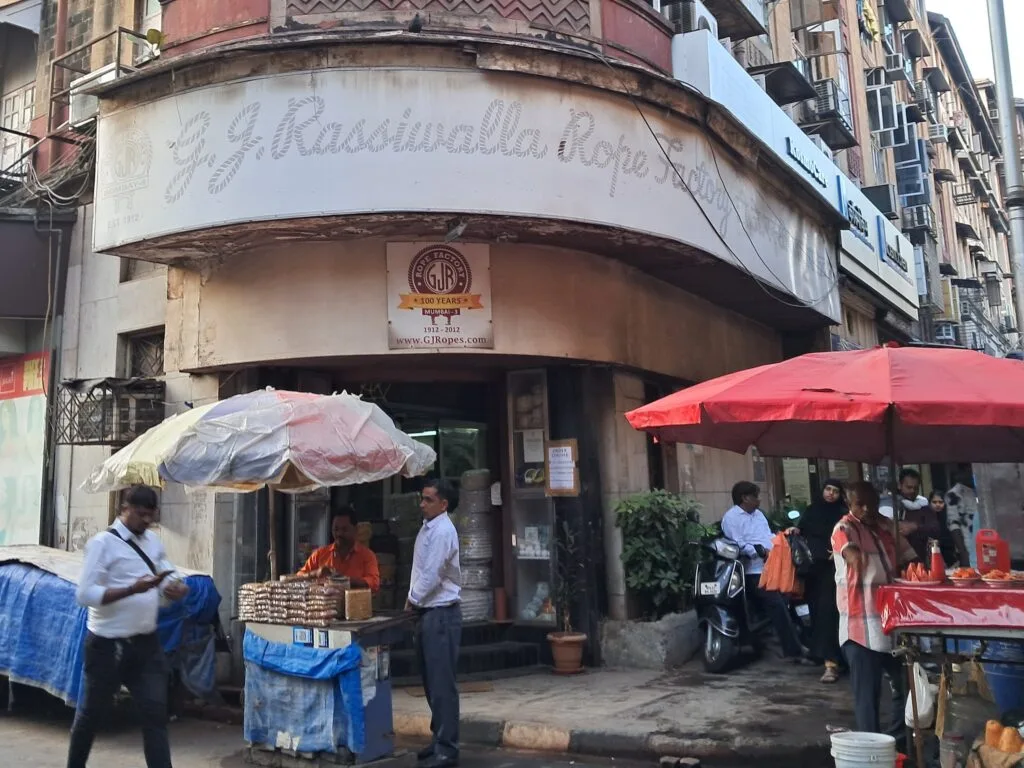
The Repair and Restoration of the G.J. Rassiwalla Rope Factory Shopfront
Jun 22, 2026
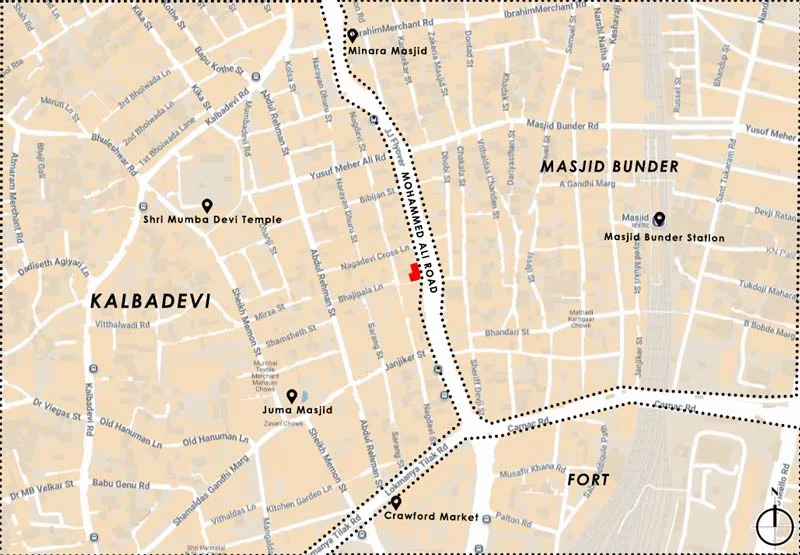
Along the industrious Mohammed Ali Road, lies a historic business that has been manufacturing rope, twine and cord since the early 20th century. Over the last 114 years the G.J. Rassiwalla Rope Factory has established itself as the de facto business for rassi (rope) production in the city. In 2002, the landmark shop, along with the modern heritage building it has been housed in, was hidden due to the construction of the J.J. Flyover, which inadvertently increased traffic and the general chaos of the neighbourhood. It was thus essential that the historic Rassiwalla shopfront be revitalised, to once again establish their presence as a local landmark; one that reflected their thriving business.
Figure 1: Map showing Maskati House, Mohammed Ali Road. Source: Art Deco Mumbai Trust
This report details the Restoration of the Rassiwalla shopfront; the cost-effective interventions that helped refresh the appearance of the historic property, whilst preserving the identity of the business. In a broader sense, it highlights the importance of celebrating and preserving modern heritage structures.
HISTORICAL BACKGROUND – A Legacy Flagship
Constructed between 1905 and 1930, Mohammed Ali Road, formerly known as Sydenham Road, was a major development by the Bombay City Improvement Trust (BIT) in hopes of decongesting the chaotic Fort area.[1] Developments along this road were given specific regulations by the BIT that buildings should be,
‘modern as regards constructional details, hygiene and planning, but at the same time in their general appearance would partake more of the traditional architecture of India rather than styles of Europe’.[2]
Designed with high standards of hygiene and planning, these buildings gave rise to a structured neighbourhood, bustling with commercial enterprises and industries from the old town. Being built through the early 1930s, these developments mostly grew as Art Deco properties; reinforced cement concrete buildings with bold geometric forms and vernacular ornamentation, a shining example of which was Maskati House.
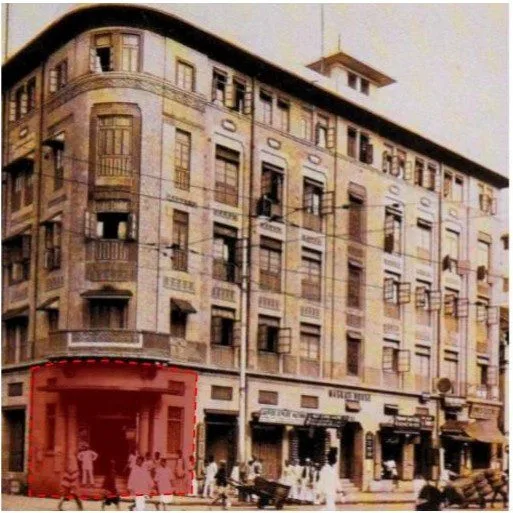
Figure 2: Archival Image of Maskati House. Source: House of Maskati: One Indian Family’s Siamese Textile Legacy by Sarah Rooney with Prapassorn Posrithong and Sakib Maskati. Narisa Chakrabongse, 2017
Maskati House, a streamlined building on Mohammed Ali Road, was commissioned by the prominent Maskati family. The Maskatis, at the time, were one of the largest textile conglomerates in the world, exporting colourful Indian-made fabrics to countries like Siam (Thailand), Singapore, Cambodia and Burma (Myanmar). Theymoved into their first officialheadquarters i.e. Maskati House in 1935. Designed by the Bombay-based firm Messrs. Adalja & Noorani, the five-storey building was constructed within a reinforced concrete frame, clad in a delicate mix of Malad stone and red stone ornamentation. The use of materiality and technology made it one of the most expensive projects on the street, costing around Rs 3,50,000 in total.[3] It was on the ground floor, at the corner of this grand building that a fast-growing rope factory found its home.
The G.J. Rassiwalla Rope Factory was born in 1912 from the vision of Mr. Gulamhusein Jafferbhai Rassiwalla, a cotton-waste dealer who transformed the industry of rope manufacture in the city.[4] Starting from a slate of cotton and jute rope, the firm delved into a variety of new materials and typologies of rope, serving the city’s industrial and logistic needs for the next century. It was this business boom that led his son, Mr. Hasanali Gulamhusein Rassiwalla, to open the first retail outlet of the company at Maskati House in 1952. The business later grew at the helm of his sons; Mr. Gulamabbas Rassiwalla and Mr. Gulamhyder Rassiwalla. The shop on Mohammed Ali Road, where it still stands, 74 years later, dominating the corner of Maskati House, expanded with a larger inventory of ropes – natural fibres, nylon, plastic, biodegradable, etc., that were soon exported all over the world.[5] Over time, the shopfront began to show signs of wear and tear. At the direction of Mr. Sibtain Rassiwalla, 4th generation owner, a revitalisation of the shop front was undertaken.
In the owners’ initial conversations with local signage vendors for the repairs of the boarding, suggestions were made to replace the entire wooden boarding with Aluminium Composite Panels (ACP). Being sensitive to the historicity of the property, they were determined to restore the frontage of the shop in an authentic manner, without compromising the integrity of the heritage property. Art Deco Mumbai Trust (hereon, referred to as the Conservation Team) was approached by the Rassiwallas, after a quick Google search on ‘Art Deco Restoration’. This led them to the Research Page on our website where they saw the signage work done by Art Deco Mumbai for Empress Court, Oval Maidan. The owners’ main requirement was to revive the shopfront by re-designing the signage and restoring the original Art Deco features. This had to be done respecting not only the original building features, but also the iconic brand identity of the Rassiwalla shop – a sleek modern sign, with a rope-design typeface.
Figure 4: The logo on the letterhead of the G.J. Rassiwalla Rope Co. Source: G.J. Rassiwalla Rope Co.
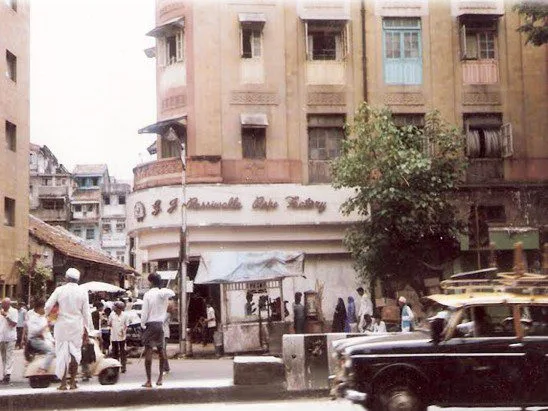
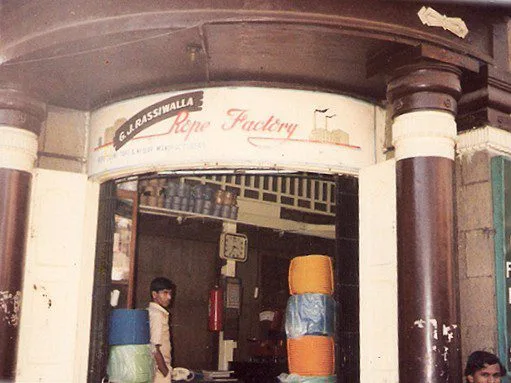
The Rassiwalla shopfront had seen many changes since its inception, beginning with a small hand-painted sign right above the entrance (figure 5). In the 1960s, a professional type-designer was commissioned to design the now iconic signage, with the winding rope font.[6] This was then materialised in 3D lettering on a sign that spread across the entire front facade of the shop (figure 3). Much later, the old signage was replaced with a simple wooden board celebrating their centenary year (figure 6). With the passage of time, this signage aged and a new one was to be imagined, borrowing from the older iterations.
Figure 5: Archival Image of the G.J. Rassiwalla Rope Factory, with its first signage (1952). Source: G.J. Rassiwalla Rope Co.
The Conservation Team inferred that any attempt to revitalise the shopfront would require removing all the additions, alterations and layers added over the years, to expose the original building features. After a meticulous documentation process, the old timber panel signage was carefully removed, uncovering intricate detailing hidden below.
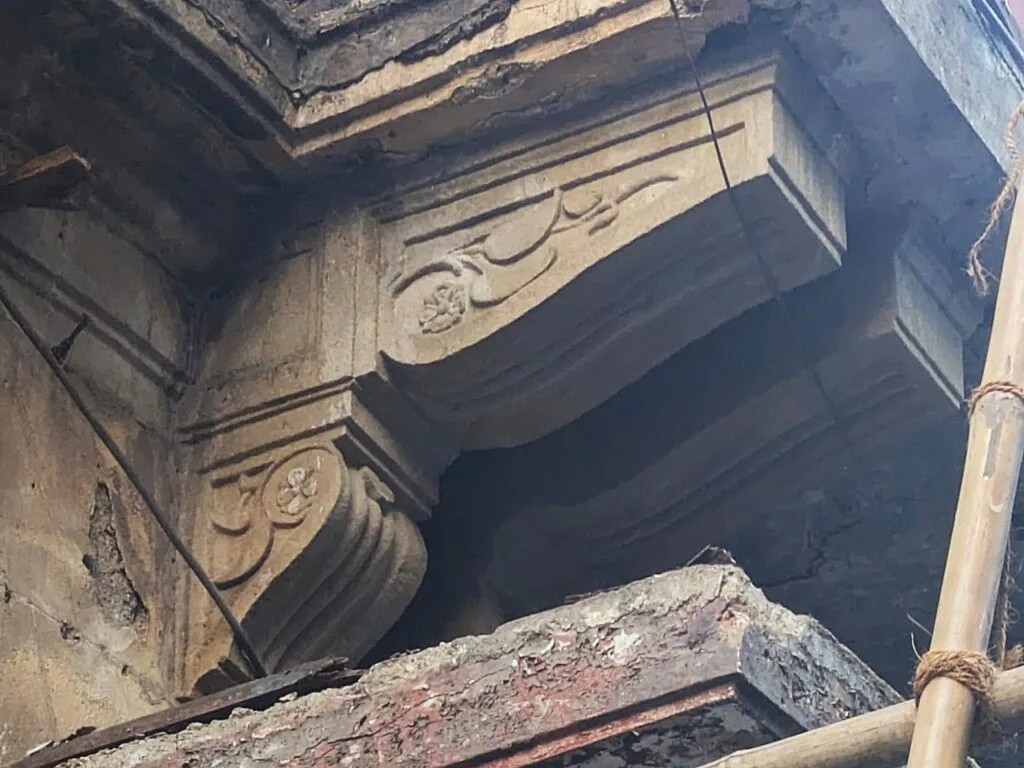
Figure 7: Decorative brackets discovered after the boarding was removed. Source: Art Deco Mumbai Trust
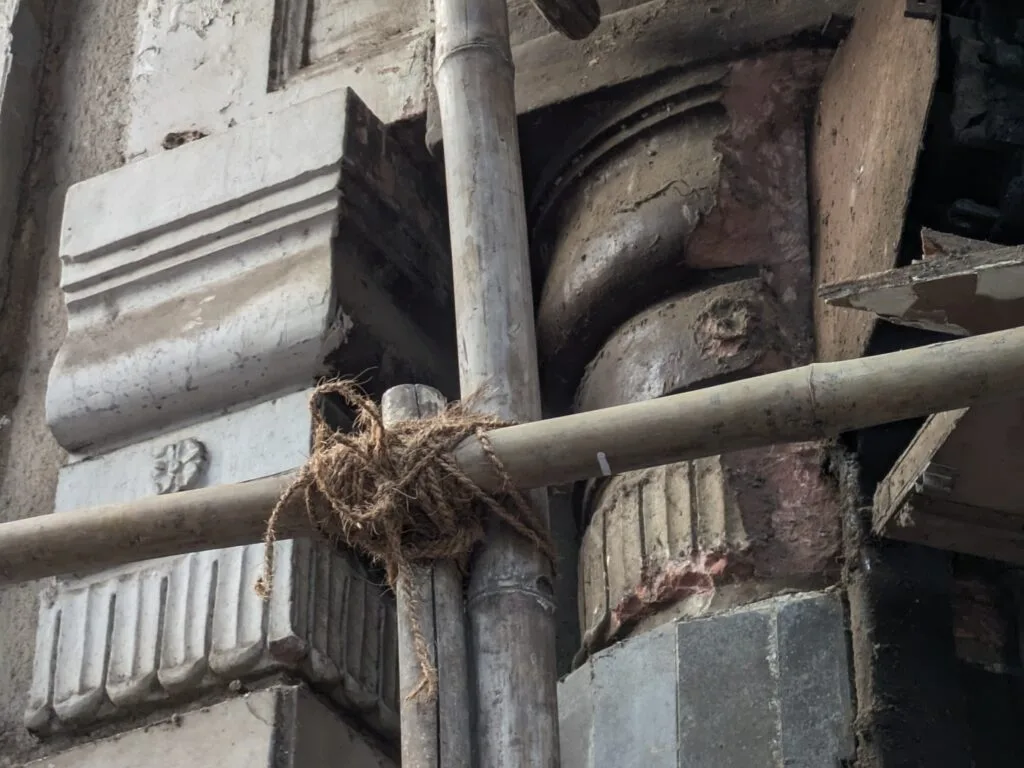
Figure 8: Abstracted classical column capitals discovered after the boarding was removed. Source: Art Deco Mumbai Trust
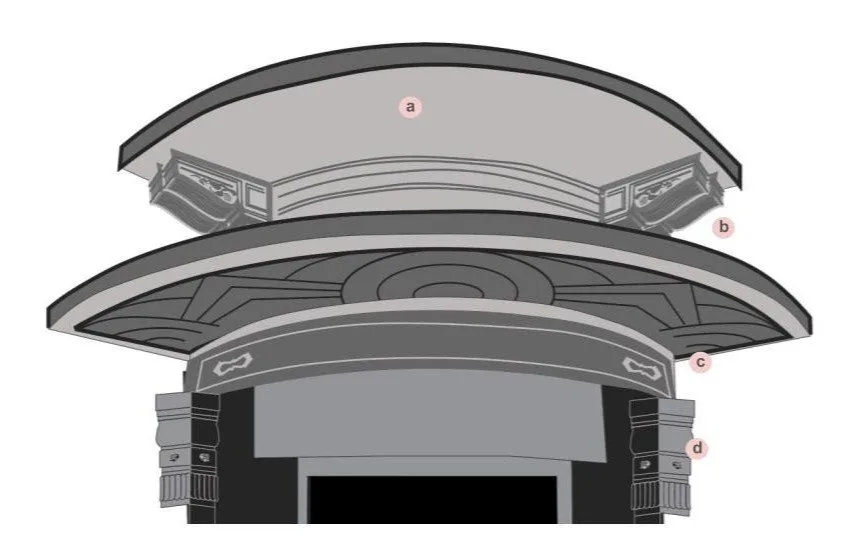
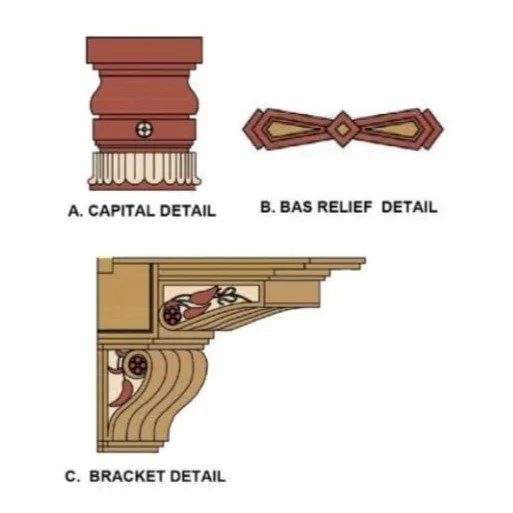
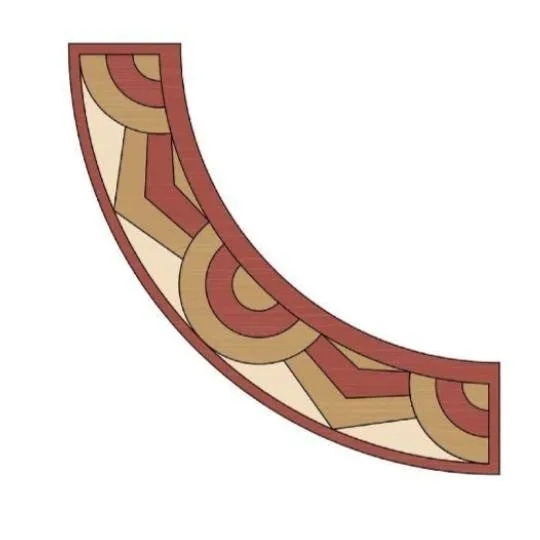
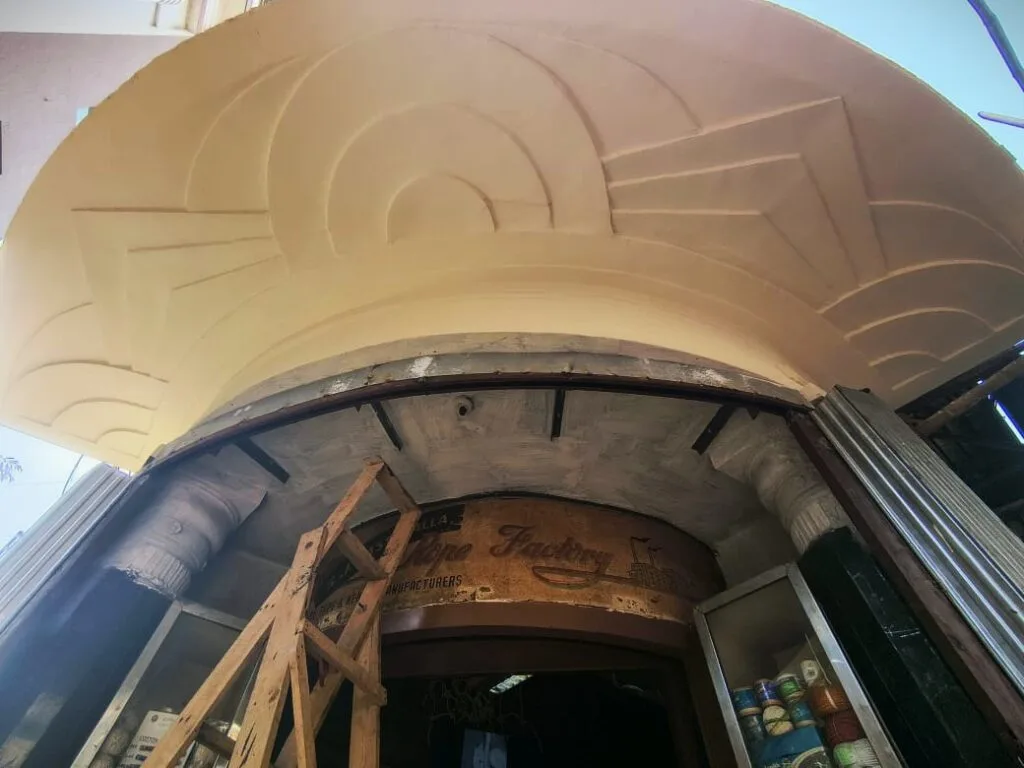
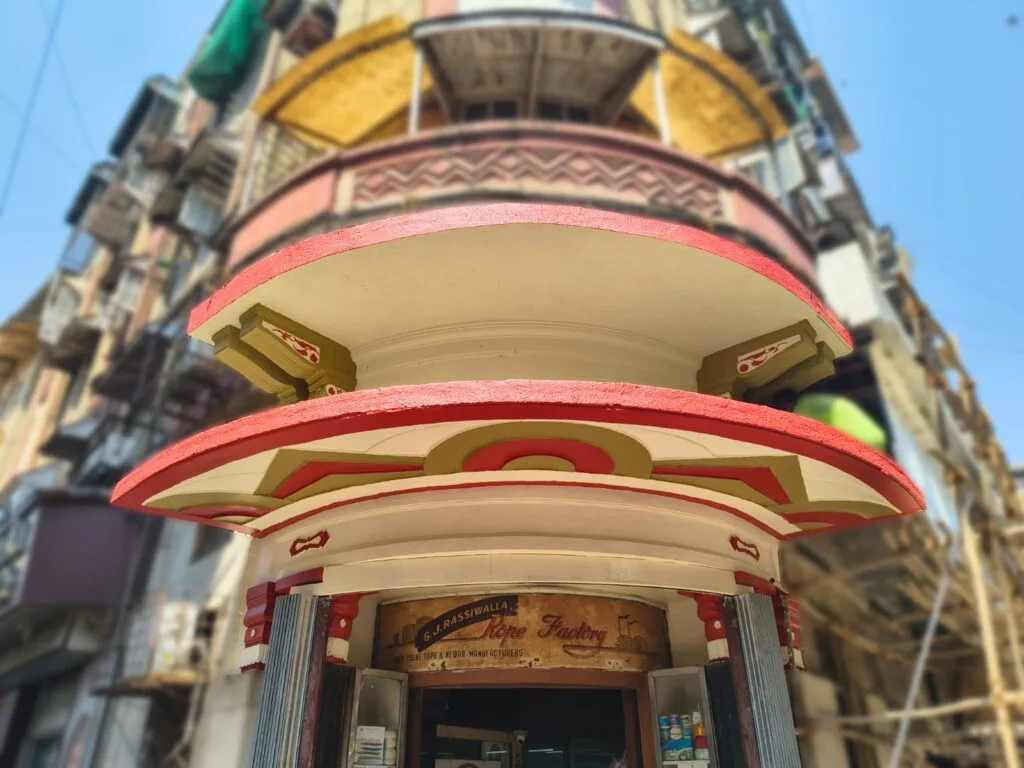
The original corner shopfront was designed with two column supports on either side of the entrance and shaded by a single protruding canopy. The canopy followed the curve of the building corner, with a sunburst-geometric motif carved on its underside. The columns on either side of the entrance featured carved capitals, with tropical imagery reminiscent of ancient Egyptian design. The supporting walls on either side of the columns also featured similar capitals. A curved balcony above the shop acted as a second, smaller canopy above the entrance, and was supported by four brackets. These brackets also featured tropical imagery carved on its surface. The existing shop sign concealed the column details, the brackets and geometric bas reliefs; all hidden, but intact, after all these years.
Figure 9: An illustration of the GJ Rassiwalla shop front denoting a. The upper canopy, b. Carved brackets, c. The lower canopy, d.Carved capitals. Source: Art Deco Mumbai Trust
Step 3: Restoration
Figure 10: The sunburst bas relief on the underside of canopy, after manual cleaning- Step 3A. Source: Art Deco Mumbai Trust
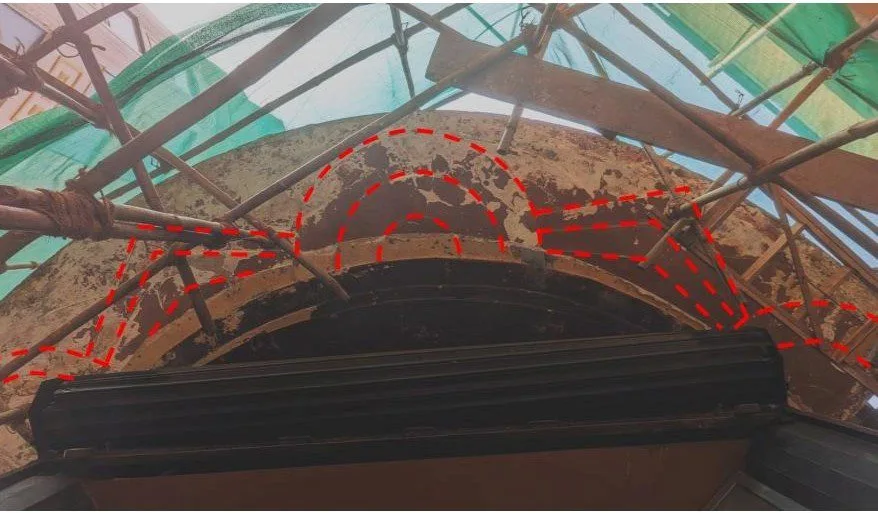
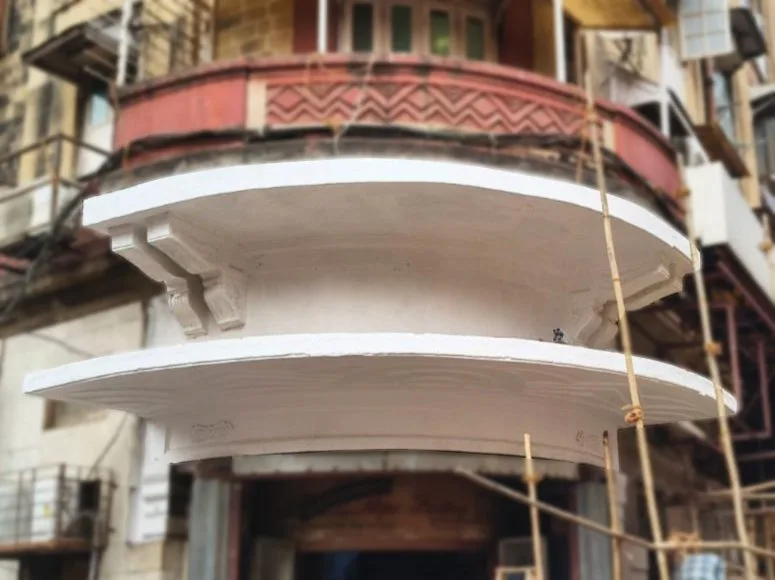
After on-site sketches were made of all the Art Deco elements that were discovered, a comprehensive scheme for repairs and surface-cleaning was devised. The larger canopy was cleaned; its original paint layer was carefully scraped and removed, keeping in mind the delicate sunburst bas-relief on the underside. The upper canopy needed minor structural repairs due to crack formation and moisture seepage. The repair methodology incorporated use of micro concrete to fill in the cracks. The other elements of the storefront, including the brackets, column capitals and the smaller bas relief motifs were manually cleaned by means of careful scraping, the surface was then primed, and made ready for paint.
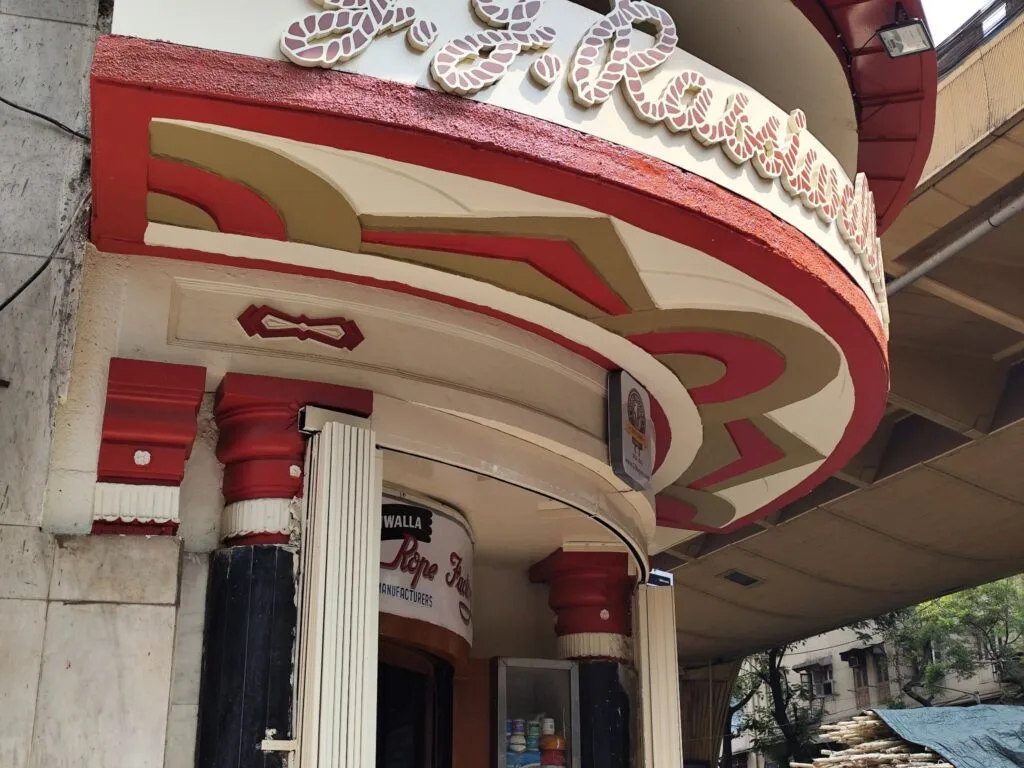
While devising the colour scheme for the newly restored storefront, inspiration was taken from archival images as well as the original material colors of Maskati House; the cream painted staircase tower, yellow ochre of the Malad Stone and red for the red sandstone.[7] The proposal included a three tone colour scheme, typical to Art Deco buildings, which highlight intricate details in a darker colour, a lighter colour as the background, and a middle tone to balance the contrast.
Figure 11: Proposed Colour Scheme for the details of the G.J. Rassiwalla shopfront. Source: Art Deco Mumbai Trust
Figure 12: Proposed Colour Scheme for the underside of the lower canopy of the G.J. Rassiwalla shopfront. Source: Art Deco Mumbai Trust
Figure 13: The shopfront, after two coats of white primer. Source: G.J. Rassiwalla Rope Co.
Figure 14: The underside of the shopfront canopy, after two coats of primer. Source: G.J. Rassiwalla Rope Co.
Figure 15: The restored details under the canopy, after completion. Source: Art Deco Mumbai Trust
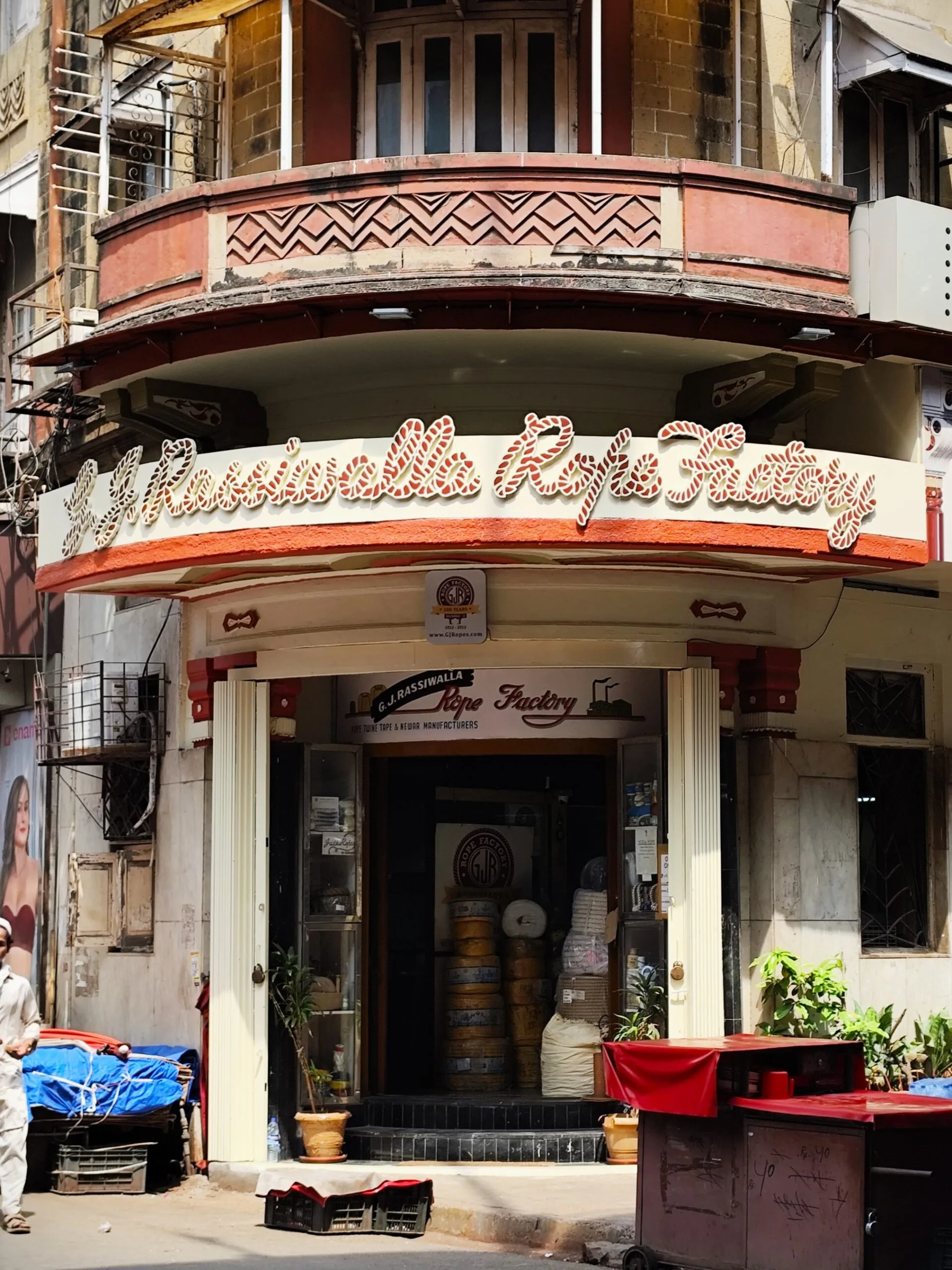
Figure 16: The restored shopfront, after painting was completed. Source: G.J. Rassiwalla Rope Co.
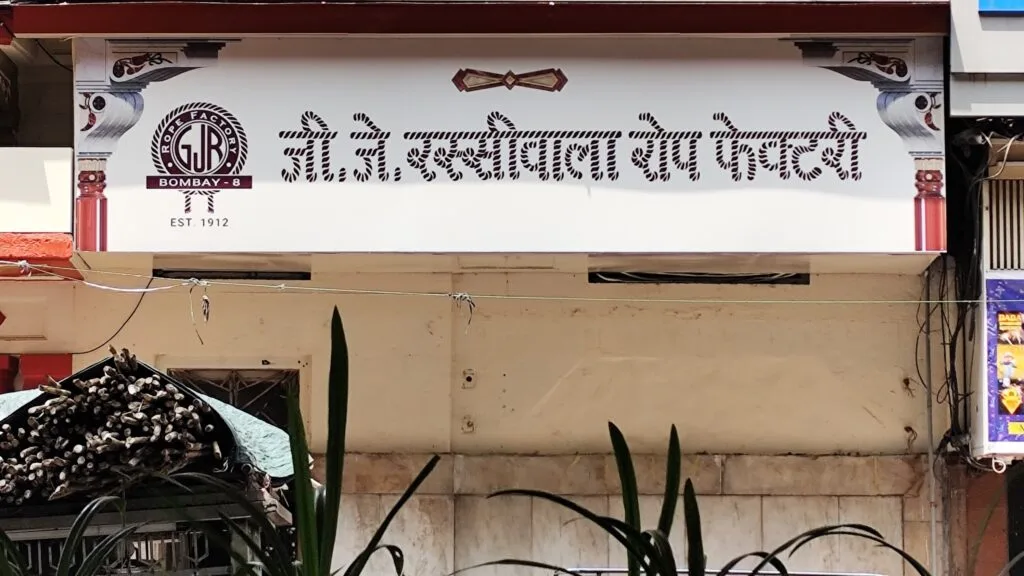
The side of the shop facing Mohammed Ali Road featured plain white marble cladding and planters at the base. The cladding was manually cleaned, with non-intrusive chemicals or methods, while the planter was painted in the same shade of red. It was decided by the Client that the cladding would be retained, while the upper portion would be used for the Devanagiri signage of the brand, based on its original location. The new Devanagari sign was designed separately by the client, in a similar rope-design typeface and installed on a horizontal board above the cladding. This allowed for increased branding, while also hiding the wiring that once cluttered the facade.
Figure 17: Road-facing printed signage in Devanagari, designed by the client. Source: Art Deco Mumbai Trust
Step 4- Signage- Ideation
The brief for the new signage of the shop included multiple factors to consider:
1. The full company name ‘G.J. Rassiwalla Rope Factory’, with all 22 alphabets was to be placed above the shop entrance, atop the lower canopy’s circumference;
2. The signage was designed in alignment with the company branding, incorporating the unique cursive rope typeface and the company logo
3. The original Art Deco features of the building had to be retained and highlighted;
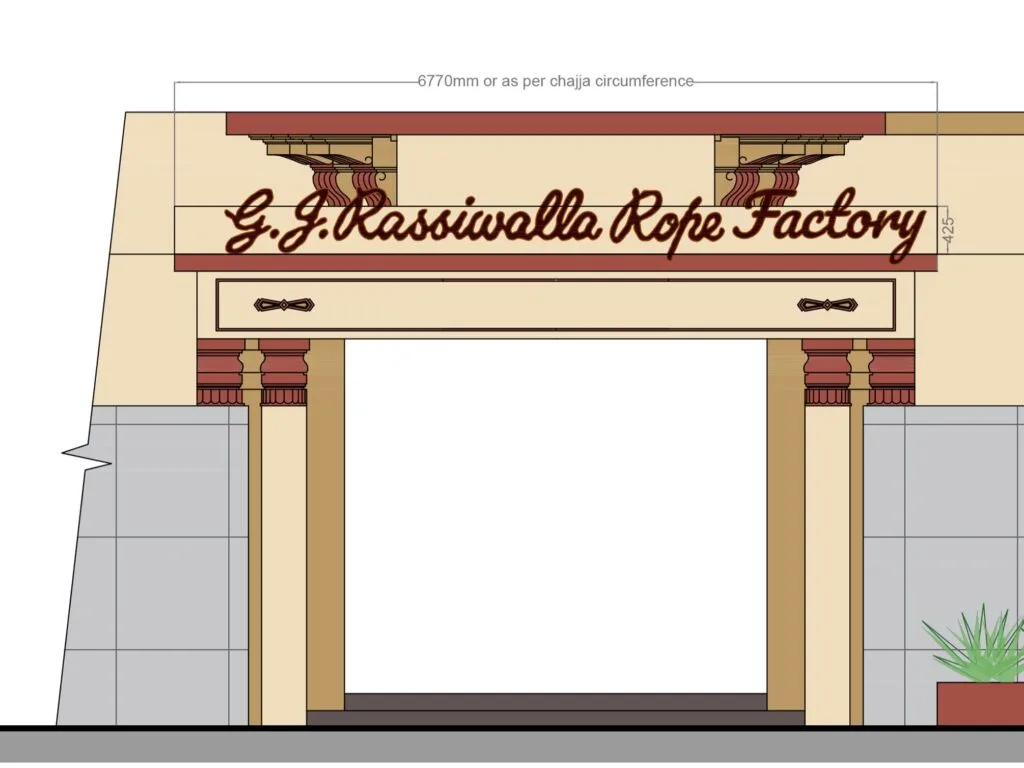
Firstly, the written calligraphy font had to be recreated and matched to the existing one since no digital copies of it were accessible. Keeping in mind these constraints, various iterations were submitted to the clients. The final version is illustrated in Figure 18.
Figure 18: Signage Option 2, Proposed Drawing of the G.J. Rassiwalla Shop Front-Opened Elevation. Source: Art Deco Mumbai Trust
This design places the entire 22-letter signage across the length of the curved canopy, in its original proportions. Though partially covering the brackets, this option was preferred as it maintained the heights of the original signage, ensuring maximum visibility.
Step 5- Signage- Material and Execution
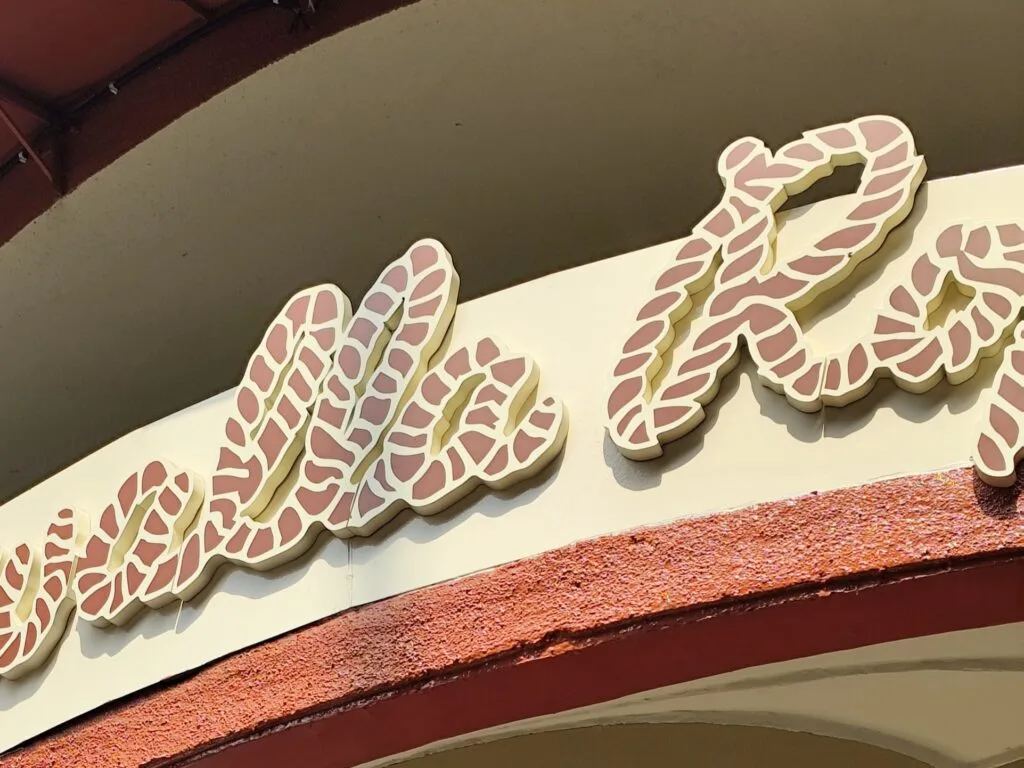
Figure 19: Detail of 3-Dimensional signage
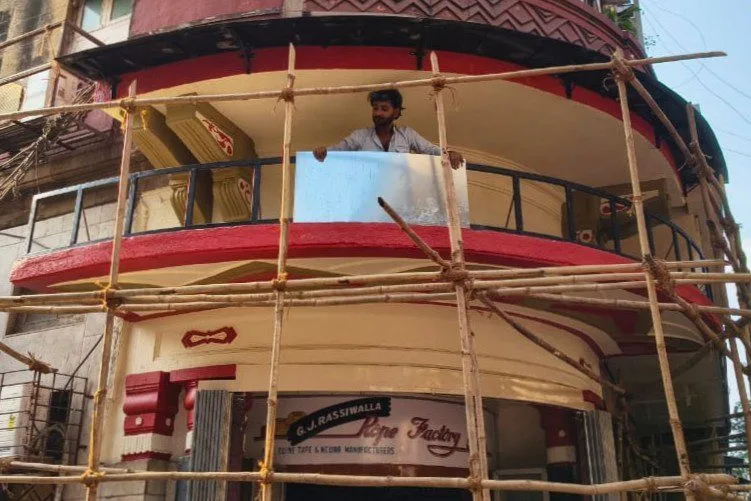
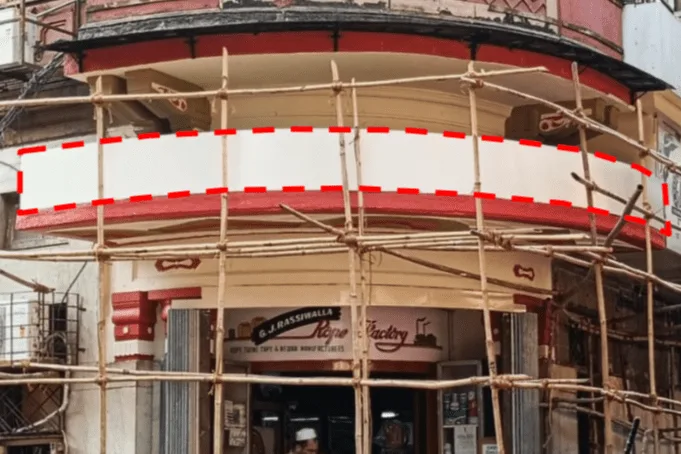
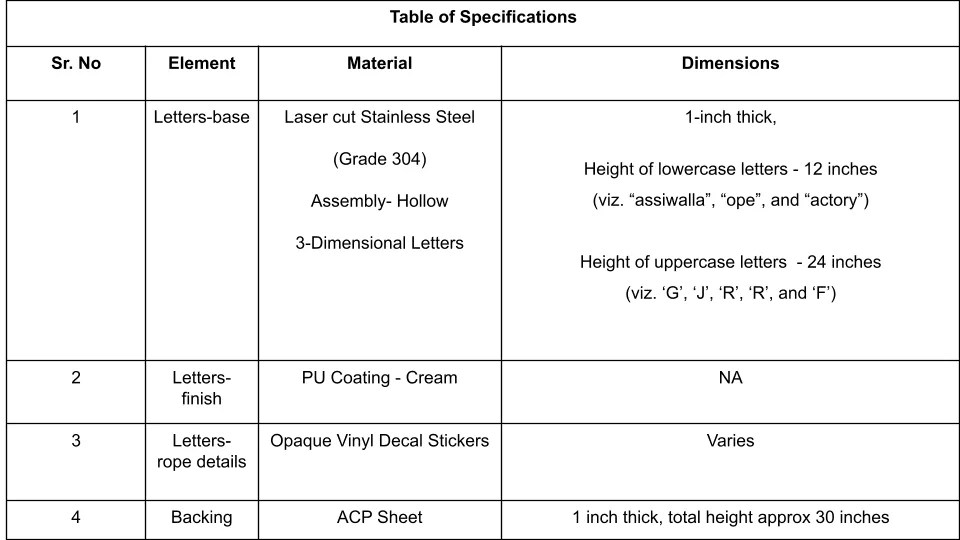
The new signage was made up of 3-Dimensional lettering anchored on a robust backing. After a process of eliminating the various anchoring options such as mesh backing, plywood backing, and MS grid backing, the least intrusive and sturdy option was chosen. A solid backing in a flexible ACP(Aluminium Composite Panels) sheet was provided as the base with the letters fixed to the board (Figure 19). The height of the signage was such that the lowercase letters would be fully fixed on the backing, while the five uppercase letters had a slight extension above the backing (Table 1). This ensured stability of the signage while also keeping the brackets visible. The ACP sheet was thus placed on the edge of the lower canopy and painted in a similar colour scheme as the building, for a seamless appearance (Figure 20).
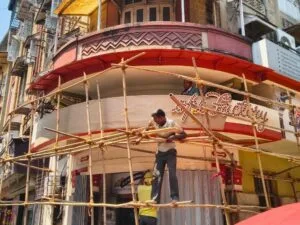
Figure 20: Installation of the ACP Sheet backing mounted on a MS grid frame. Source: G.J. Rassiwalla Rope Co.
Figure 21: The ACP Sheet backing painted in the Cream colour to blend with the background. Source: G.J. Rassiwalla Rope Co.
As recommended by the vendor Jemco Arts, the cursive lettering was fabricated in Stainless Steel (Grade 304) in the rope-style design of the original logo. After the logo was recreated digitally, SS sheets were laser-cut to match the profile of the letters and joined to form a hollow 3-Dimensional frame. This allowed appropriate usage of material in a cost effective manner. The finishes and details are listed in the table of specifications . After fabrication, the text was bolted onto the backing, beginning from the last word (See figure 22).
Table 1
Figure 22: Installation of the SS Lettering onto the ACP backing. Source: G.J. Rassiwalla Rope Co.
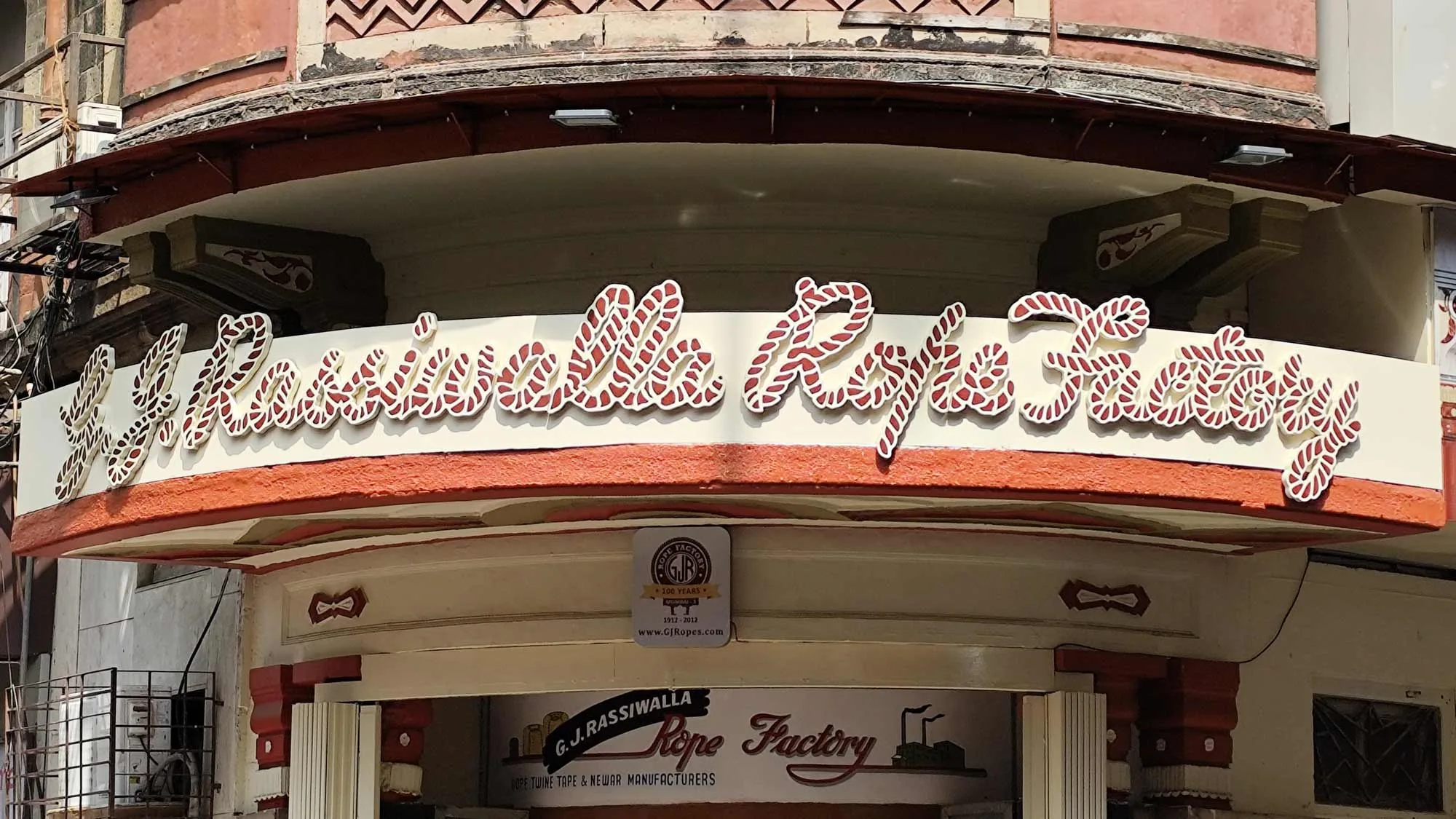
Figure 23: The completed new signage of the G.J. Rassiwalla Rope Co. Source: Art Deco Mumbai Trust
CONCLUSION- Maintaining Authenticity
The Rassiwallas required a shopfront that would not only celebrate the legacy of their business, but also the historic building that houses it. What was initially imagined as a simple signage refurbishment, turned out to be an elaborate revamp of the storefront, which led to new discoveries and a meticulous restoration project.
Commercial neighbourhoods in Mumbai are known for being lively and active throughout the day. In especially historic ones like Mohammed Ali Road, growing one’s business and its day-to-day activities takes precedence over the upkeep of built heritage. It was through the initiative of the owners and a greater collaborative effort that led to an appealing and authentic upgrade. A simple requirement to redesign the signage led to a holistic shopfront design that celebrated the shop’s unique identity, while respecting the building.
In a time of demolition and redevelopment, Art Deco Mumbai Trust continues to believe in the idea that small interventions and maintenance can go a long way in adding to the value while retaining the legacy of a property.
By Varada Phadkay and Joshua Fernandes for Art Deco Mumbai Trust.
Header Image Source: Art Deco Mumbai Trust
References
[1]. Bombay-The Cities Within by Sharada Dwivedi and Rahul Mehrotra. India Book House, 1995.
[2]. House of Maskati: One Indian Family’s Siamese Textile Legacy by Sarah Rooney with Prapassorn Posrithong and Sakib Maskati. Narisa Chakrabongse, 2017
[3]. House of Maskati: One Indian Family’s Siamese Textile Legacy by Sarah Rooney with Prapassorn Posrithong and Sakib Maskati. Narisa Chakrabongse, 2017
[6]. As mentioned by Mr. Sibtain Rassiwalla, G.J. Rassiwalla Rope Co.
[7]. House of Maskati: One Indian Family’s Siamese Textile Legacy by Sarah Rooney with Prapassorn Posrithong and Sakib Maskati. Narisa Chakrabongse, 2017